





















Gains in many mega-cap stocks help to bolster US indexes performance; Microsoft took center stage after announcing plans to invest $10 billion in OpenAI, the company behind the hit ChatGPT
GLOBAL CAPITAL MARKETS OVERVIEW, ANALYSIS & FORECASTS:
Author: Dr. Alexander APOSTOLOV (researcher at Economic Research Institute at BAS)
The Dow rose more than 100 points on Tuesday, while the S&P 500 and Nasdaq 100 gained 0.5% and 0.6%, respectively, as investors reassessed the outlook for economic growth and monetary policy. Risk appetite has been fueled by hopes that China's reopening will boost the country's and other economies' growth prospects, despite concerns that the country's reopening could also spark a new wave of COVID-19 infections. On the policy front, Federal Reserve President Michelle Bowman was one of the latest officials to warn that interest rates must be raised further to curb inflation. Meanwhile, in a speech to the Riksbank, Chairman Jerome Powell stressed that the central bank must remain immune to political influence while noting that climate change should not be a priority for monetary policymakers. Finally, Microsoft took center stage on the enterprise front after announcing plans to invest $10 billion in OpenAI, the company behind the hit ChatGPT.
The Canada S&P/TSX Composite hovered below the 19,800 level on Tuesday, tracking gloomy sentiment on Wall Street, offsetting modest gains from the previous session, as investors continued to assess the Monetary Policy Outlook. Heavily weighted energy producers led losses, with crude oil prices down nearly 1.5% on average, despite a slight intraday gain. Bank shares also fell from one-month highs in the previous session.
The Baltic Exchange's dry bulk shipping index, which measures the cost of shipping goods worldwide, fell about 3.8% to 1,096 points, its lowest since September 2, as shipping activity shipping remained quiet at the start of the year. The Panamax index, which tracks between 60,000 and 70,000 tons of cargoes of coal and grain, fell for the 12th consecutive day, falling 4.9% to a more than two-year low of 1,189 points; and the Capesize index, which tracks iron ore and coal cargoes of 150,000 tons, fell 3.8% to 1,536 points. Among smaller vessels, the supramax index fell for the thirteenth consecutive session by 22 points to 803 points.
European shares closed lower on Tuesday, with the benchmark Stoxx 600 down 0.6% from Monday's closing high in more than eight months, led by declines in retail companies. Among individual stocks, Belgian shipping company Euronav was the worst performer, falling 17.7 percent on news that a potential merger with rival Frontline fell through. Domestically, Germany's DAX fell 0.2 percent before gaining 4 percent after drugmaker Bayer said annual sales of its new blood-clotting drug could exceed 5 billion euros. Investors have evaluated statements by several Fed officials, including Fed Chair Jerome Powell, and comments from some European Central Bank policymakers. ECB board member Isabel Schnabel said funding conditions would need to become tighter to tackle persistent inflation, adding that interest rates would rise steadily to ensure inflation returned to the 2% mark in time Target. The CAC 40 index fell about 0.6% on Tuesday to close at 6,869 points, below the previous session's 11-month high, affected by hawkish comments from several policymakers from the Federal Reserve and the European Central Bank. Domestically, French Prime Minister Elisabeth Borne said the government would introduce a draft law to raise the mandatory retirement age from 62 to 64 by 2030. She added that the government would gradually increase the pension age from September 1, 2023. On the data front, French industrial production rose 2% month-on-month in November, rebounding from an upwardly revised 2.5% decline in October, while consensus forecasts rose 0.8%. Leading the decline were Eurofins Scientific SE (-3.64%), Unibail Rodamco (-2.69%), and Cie de Saint-Gobain (-2.40%). The biggest gainers were Renault (+2.18%), WorldLine SA (+1.96%), and Thales SA (0.87%). The FTSE MIB closed volatile on Tuesday, just below the 25,365 level, easing off a 10-month high hit in the previous session. Investors continued to assess hawkish signals from Fed officials overnight on the reopening of the Chinese economy. Utility providers and technology stocks led losses in Milan, with Enel down more than 1 percent. While recording smaller losses, Nexi shares fell 0.3% after Barclays cut its recommendation on the technology company, citing lower credit card usage as the European Central Bank raises interest rates. On the other hand, the heavily weighted banking sector fell sharply, with Finecobank up 1.2%. The Madrid IBEX 35 index managed to close up about 0.2% at 8,711 on Tuesday, returning to levels not seen since early June last year and outperforming its regional peers. Shares of Naturgy rose more than 2% after Australian fund MFI said it increased its stake in the Spanish gas company to 14% from 11.185%. The banking sector also posted solid gains, led by Unicaja. Bucking the trend, INM Colonial and Grifols fell 2% and 1.9%, respectively, the maximum within the selective. Meanwhile, investors have digested the latest hawkish remarks from major central bank policymakers suggesting there will be more interest rate hikes to control inflation as the World Bank lowered its forecast for the world economy in 2023.
Shares in London tumbled for five days on Tuesday, dragged down by technology and real estate sectors, with the blue-chip FTSE 100 retreating from an almost record closing high to below 7,700. Data showed that UK retail sales accelerated in December but remained well below the pace of UK inflation. Overall, market sentiment has weakened amid recession fears and hawkish comments from some Fed officials, throwing cold water on the idea that rate hikes are over. In terms of individual share price movements, RS Group and BAT were among the biggest laggards in the FTSE 100, down around 4.4% and 3.8%, respectively.
Russia's ruble-based economy ministry index fell 0.3% to 2,158 on Tuesday, reversing gains made in the previous session, as investors continued to assess the extent to which commodity markets and the isolation of Russia's economy will affect growth this year, with raw materials related. The industry is under pressure again. Oil stocks led losses, with Transneft, Surgut, and Lukoil each down nearly 1 percent. Contracts for Urals crude grades are selling for as low as $38 a barrel at the port of Primorsk, less than half the price of the Brent benchmark, under pressure from Western embargoes as China and India scramble, according to Argus data. In addition, soaring shipping costs have limited demand. Miners and metallurgists also posted losses, with Mechel down 1.6 percent, as the stronger ruble hurt export demand.
The China Shanghai Composite fell 0.21% to close at 3,170. In comparison, the Shenzhen Composite rose 0.49% to close at 11,570 in mixed trade on Tuesday, as investors took profits after a strong rally driven by China's swift lifting of COVID-19 restrictions. At the same time, continue to assess the economic outlook. In addition, investors have also turned cautious about the Lunar New Year amid concerns that increased travel could lead to a spike in COVID-19 cases. Elsewhere, weak overnight trading on Wall Street dented sentiment as concerns over higher peaks in growth, inflation, and interest rates continued to loom over financial markets. As a result, heavyweight financial stocks fell, with Ping An Insurance (-3.3%), China Merchants Bank (-1.4%), and Ping An Bank (-2.4%) falling significantly. Growth stocks, meanwhile, mostly rose on growing expectations that inflation may ease, including new energy, technology, and healthcare companies.
Hong Kong shares fell 33 points, or 0.15%, to 21,355 in early trade on Tuesday, retreating from a near six-month high hit the previous day, after Wall Street's benchmark gave up earlier broad-based gains to close mixed, with the Fed chief Powell is due to speak later today ahead of inflation data on Thursday. Meanwhile, fears are growing that coronavirus cases in China could spread to rural areas as millions of people are expected to travel to the country for Lunar New Year celebrations later this month. Beijing has reportedly notified local authorities to set up fever clinics and increase supplies of medicines before the Lunar New Year holiday. Technology stocks and cyclical consumer stocks fell. Orient Overseas International (-2.3%), NetEase Co., Ltd. (1.8%), and Alibaba Group Hlds fell in early trading. (-1.7%), Meituan (-1.6%) and Zhongsheng Group (-1.4%). Shares of China Education Group fell about 9%.
The Japan Nikkei 225 rose 0.78% to close at 26,175 on Tuesday, while the broader Topix gained 0.27% to close at 1,881 on Tuesday, its third straight session of gains, with Japanese technology shares tracking their U.S. peers higher. The tech-heavy Nasdaq rose for a second session on growing expectations that U.S. inflation may be easing, although investors remained cautious as hawkish comments from Fed officials offset. That fueled hopes that the Federal Reserve might ease its aggressive monetary tightening policy. Meanwhile, data assessed by investors showed core inflation in Tokyo beat expectations in December, while Japanese household spending unexpectedly fell in November. The tech sector led gains with SoftBank Group (2.4%), Tokyo Electron (3.1%), Lasertec (4.5%), Keyence (1.4%), and Murata Manufacturing (2.4%). In corporate news, drugmaker Eisai Co jumped 4.8 percent after the U.S. Food and Drug Administration approved its Alzheimer's disease drug lecanemab.
On Tuesday, the New Zealand ANZ 50 rose 18.81 points, or 0.16%, to 11665.26 in subdued early trading amid reports that Morgan Stanley followed Goldman Sachs Group in its bullish call on Chinese assets amid swift cancellations. Zero COVID measures have boosted the country's growth prospects. Separately, developing-nation stocks entered a bull market on Monday after China fully opened up and the dollar weakened. However, gains were limited amid caution ahead of Thursday's U.S. CPI data and hawkish comments on interest rates from Federal Reserve officials on Monday, who said U.S. borrowing costs could reach above 5% and remain unchanged for some time. Shares in energy minerals, business services, and productive manufacturing closed in the green. Sky City Ent. Fletcher Building, Meridian Energy, and Auckland Intl. rose 1.5 percent, 1.1 percent, and 0.6 percent, respectively.
The Australia S&P/ASX 200 fell 0.2% to close around 7,117, snapping a four-day winning streak dragged down by losses in the energy and mining sectors. Weak trading on Wall Street overnight also dented sentiment as concerns over growth, inflation, and higher interest rate peaks continued to loom over the market. Heavyweight energy and mining stocks led the decline, with Woodside energy (-0.4%), Santos (-0.7%), Whitehaven Coal (-0.9%), BHP Group (-0.6%), and Fortescue Metals (-1%) falling significantly. Gold stocks also fell, including Newcrest Mining (-1.2%), Evolution Mining (1.2%), and Northern Star Resources (-1.7%). Elsewhere, technology stocks also fell, while healthcare companies rose.
On Tuesday, the India BSE Sensex extended early losses to close at 60,115, down 681 points, tracking losses in other Asian stock markets and almost undoing sharp gains in the previous session, weighed by hawkish comments from Fed officials overnight and a gloomy outlook for India's economy. Tech stocks led losses after top IT services provider TCS missed its profit forecast for the third quarter of the current fiscal year and warned of grim economic conditions ahead, underscored by a slowdown in India's gross domestic product (GDP) for the period. However, the consultancy firm recovered partly from intraday lows to close 1 percent lower, while Tech Mahindra and Infosys were not far behind, down 1.2 percent and 0.9 percent, respectively. On the other hand, strong corporate results from Jaguar Land Rover supported Mumbai's auto sector growth. Traders now await domestic and U.S. inflation on Thursday.
Brazil's Ibovespa stock index traded slightly below the 109,000 level on Tuesday, down from more than two-month highs in the previous session, as investors rated Federal Reserve chairman Jerome Powell's speech after that two other US central bank officials expressed concern about the trajectory of interest rate hikes. Locally, Lula's chief of staff said the attack on state institutions in Brazil on Sunday would not delay the actions planned by President Luiz Inacio Lula da Silva's economic team, including the announcement of the first financial measures at the end of this week. On the data front, Brazilian inflation slowed to a nearly two-year low of 5.79% year-over-year in December, but above market estimates of 5.6% and the bank's target range central 2%-5%. Among individual stocks, the biggest losers were Qualicorp, Weg, and Sao Martinho, down more than 1% each, while Pao de Açucar was advancing more, adding more than 4%.
REVIEWING THE LAST ECONOMIC DATA:
Reviewing the latest economic news, the most important data is:
- BG: Retail sales in Bulgaria rose 4.7% year-on-year in November 2022, the fastest growth in six months and accelerating sharply from 0.6% growth the previous month. The main upward pressure came from sales of textiles, clothing, footwear, and leather goods in specialized stores (55.7% against 24.1%), automotive fuel in specialized stores (14.9% against 6.5%) and audio, video, hardware, paint, and glass equipment (16.6% versus 7.4%). Meanwhile, sales declined for food, beverages, and tobacco (-6.4% versus -5.4%). On a month-to-month basis, retail sales rose 2.2% in November, compared with an upwardly revised 0.3% increase in the prior month.
- GE: Electricity prices in Germany fell below €100/MWh in January, falling further from their peak of €450/MWh in December due to sharply lower gas prices, rising renewable energy production, and falling demand. Renewable energy will account for 46.9 percent of Germany's electricity consumption in 2022, an increase of 4.9 percentage points compared to 2021, as sunny weather and new solar generation boost solar power generation. In addition, the country's wind power generation hit a record high on Jan. 4. Overall. However, electricity consumption was reduced due to higher energy prices and warmer-than-usual temperatures. On the political front, Germany announced a cap on household electricity prices of 40 cents per kWh, or 80% of actual consumption. For industrial consumers, electricity will be capped at 11 cents per kWh, accounting for 70% of the previous year's consumption.
- FR: French electricity prices fell to €250/MWh in January, the lowest since April, as a warmer winter in Europe and improvements in LNG facilities caused TTF gas prices to plummet from their peak, reducing feedstock costs for major utilities. Still, prices remain well above their European neighbors as the country's vital nuclear energy sector continues to run below capacity. State-dominated power company EDF extended the shutdown of two reactors by four months and warned that seven more would be under extended maintenance in December. The suspension of parts of the nuclear fleet due to corrosion problems and cooling water shortages in early 2022 has heightened concerns about energy rationing in the country, forcing France to switch from one of Europe's main energy exporters to an energy importer.
- FR: In November 2022, French industrial production rose by 2% month-on-month, rebounding from an upwardly revised 2.5% decline in October, while the market forecast growth of 0.8%. Manufacturing (2.4% vs. -2%) increased production, mainly coke and refined petroleum (90.6% vs. -46.9%). On the other hand, production fell in construction (-1.2% vs. 1.1%), mining and quarrying, energy, water supply, and waste management (-0.6% vs. -5.3%). As a result, industrial production rose 0.7 percent year-on-year, reversing a 2.7 percent decline in the previous month.
- US: The U.S. IBD/TIPP economic optimism index fell to 42.3 in January 2023 from 42.9 in December, well below the 49.6 average over the past 20 years. Moreover, the index has remained pessimistic for 17 consecutive months as Americans' view of the U.S. economic outlook has deteriorated, even as inflationary pressures continue to ease. The six-month outlook for the U.S. economy slipped 1.5 points to 36.2. The sub-index of personal finance fell by 0.3 points to 49.9, gradually returning to the pessimistic range, and the support for the federal economic policy was 40.7.
- US: U.S. wholesale inventories rose 1% from the previous month to $933.1 billion in November 2022, in line with the preliminary estimate and up from a 0.6% increase in the previous month. Inventories of durable goods accumulated faster (1.1% vs. 0.8% in October) as inventory changes rebounded in furniture (1.4% vs. -2.2%) and professional equipment (1% vs. -0.2%), while inventories of machinery rose Still fast (2.2% vs. 2.9%). Inventory levels of nondurable goods also accelerated (0.7% vs. 0.3%), largely due to rebounds in pharmaceutical stocks (2.7% vs. -0.7%) and apparel inventories (2.3% vs. -0.5%). As a result, wholesale inventories rose 20.9% from a year earlier, slightly down from 21.9% in the previous month.
- US: The U.S. NFIB Small Business Optimism Index fell to a six-month low of 89.8 in December 2022 from 91.9 in November. The number of homeowners expecting business conditions to improve over the next six months fell 8% to -51%. Inflation remains the most important business issue, with 32% of property owners citing it as the top concern for running a business. December was also the 12th month in a row that the index was below its 49-year average of 98. "In general, small business owners are not optimistic about 2023 as sales and business conditions are expected to deteriorate," said NFIB chief economist Bill Dunkelberg. "Business owners are dealing with some economic uncertainty and persistent inflation, and they Continue to make business and operational changes to remedy."
- CN: In December 2022, Chinese banks added 1.4 trillion yuan in new yuan loans, up from 1.21 trillion yuan in the previous month and exceeding market expectations of 1.1 trillion yuan. It follows Beijing's recent efforts to boost growth in the world's second-largest economy, which has been hit hard by COVID-19 lockdowns and slowing global demand. In December, the central bank lowered the bank deposit reserve ratio by 25 basis points, releasing about 500 billion yuan of long-term liquidity to the economy. Meanwhile, Chinese policymakers have been doubling down on cuts to infrastructure spending. As a result, they considered that for 2022, the total new loans reached a record high of 21.1 trillion yuan, higher than the 19.95 trillion yuan set in 2021.
- CN: In December 2022, China's total social financing (TSF) fell to 1.11 trillion yuan from 1.99 trillion yuan in the previous month, lower than market expectations of 1.60 trillion yuan. Growth in total social financing outstanding slowed to 9.6 percent in December from 10.0 percent in November. TSFs include off-balance-sheet financings outside the traditional bank lending system, such as initial public offerings, trust company loans, and bond sales.
- SW: Total orders received by the Swedish industry fell by 6.8% year-on-year in November 2022, moderating from the 7.3% rise in the previous month. Orders from customers abroad fell by 8.1%, while those from customers in Sweden fell by 5.4%. On a seasonally adjusted monthly basis, orders fell 0.6%, impacted by negative developments in industry segments, most notably in the chemical and pharmaceutical sector (10.9%).
- SW: In November 2022, Swedish industrial output fell by 0.5% year-on-year, compared with a rise of 3.4% in the previous month. This was the first decline in industrial output since June 2022, as production in mining and quarrying continued to decline (-25.3% vs. -19.7%), and production fell sharply in manufacturing (1% vs. 4.9%). On a seasonally adjusted monthly basis, industrial production fell 2.3%, the reverse of a 0.5% increase in October.
- SW: In November 2022, Swedish household consumption increased by 0.4% month-on-month, the first increase since May. However, compared with the previous year, household spending fell by 0.3%, the first decline since 2021, mainly due to a 17.1% decline in furniture, furniture, household equipment, and consumables. On the other hand, the motorized transport, retail, and services sectors contributed the most to growth (up 6.2%).
- SW: In November 2022, the Swedish economy contracted by 0.5% month-on-month, suspending two consecutive months of growth, and the manufacturing and several major service industries generally declined. However, the economy grew by 0.7% compared to the previous year.
- UK: UK retail sales rose 6.5% year-on-year in December 2022, accelerating from 4.1% growth in November last year due to higher commodity costs and Christmas promotions, but growth lagged behind inflation. The December figure was also the highest since January but was still well below the pace of UK inflation, which surged 10.7 percent in November and was not far from a 40-year high of 11.1 percent recorded in October. Helen Dickinson, chief executive of the British Retail Consortium, said: "After a very challenging year, inflation climbed, consumer confidence fell, and spending over the Christmas period The increase cheered many retailers. Still, despite strong sales, growth was below inflation, making December the ninth month in a row of declining sales. She added that retail faces further headwinds in 2023, as Increases in the cost of living will further constrain consumer spending.
- JP: In December 2022, Japan's core consumer price index in Tokyo's Ku district jumped 4%, rising at the fastest pace in 40 years and beating expectations for a 3.8% growth rate, suggesting that inflationary pressures are building. Tokyo's core inflation rate, a leading indicator of price trends across the country, topped the Bank of Japan's 2 percent target for the seventh month as companies continue to pass higher costs on to consumers. That could boost expectations that the BOJ may exit its ultra-loose monetary policy by adjusting its yield target. Still, BOJ Governor Haruhiko Kuroda continued to push back against hawkish-leaning speculation that the bank must continue to support the economy until the current cost-push inflation shifts to demand-driven inflation, accompanied by rising wages.
- SK: South Korea's current account recorded a deficit of $620 million in November 2022 after recording a surplus of $880 million in October. The cargo balance recorded a deficit of $157 million, down from an excess of $607 million in the same month a year earlier. On the other hand, the service balance deficit widened to US$340 million from US$280 million in the same month of the previous year, mainly due to the narrowing of the transportation balance surplus. Also, the secondary income account recorded a deficit of $140 million, compared to a deficit of $150 million in November 2021. Meanwhile, the primary income account surplus rose to $143 million from $117 million in the same month a year earlier.
- LT: Latvia's trade deficit increased to EUR 306 million in November 2022 from EUR 55.3 million in the same month last year. Imports increased by 34.2% to 2.25 billion euros, mainly due to purchases of mineral products, machinery, mechanical appliances, electrical equipment, prepared foods, and associated vehicles and transportation equipment. The main import partners were Lithuania (28.7% of total imports), Germany (10.2%), Poland (9.3%), and Estonia (8.6%). Meanwhile, exports increased at a slower pace of 20% to 1.94 billion euros, led by sales of mineral products, plant products, prepared foods and machinery, mechanical appliances, and electrical equipment. The main export partners were Lithuania (16.1% of total exports), Estonia (12.5%), Russia (6.6%), Germany (6.1%), and Sweden ( 5).
- SL: Industrial production in Slovakia decreased by 10.8% year on year in November 2022, after a 2.6% decline in the previous month and well above market expectations of a 5.5% decline. It was the sixth consecutive month of decline in industrial activity, as output declined further for the manufacturing sector (-7.1% versus -1.7%), driven by declines in transportation equipment (-8.7% against 1.7%), of rubber and plastic products (-17.6% against -10.6 percent) and metals and manufactured metal products (-14.7 percent against -9.4 percent ). On a seasonally adjusted monthly basis, industrial production decreased by 1% in November.
LOOKING AHEAD:
Today, investors should watch out for the following important data:
- EUR: Italian Retail Sales m/m, and German 10-y Bond Auction.
- USD: Crude Oil Inventories and 10-y Bond Auction.
- AUD: CPI y/y, and Retail Sales m/m.
- JPY: 30-y Bond Auction and Leading Indicators.
- NZD: ANZ Commodity Prices m/m, and Building Consents m/m.
KEY EQUITY & BOND MARKET DRIVERS:
Кey factors in the stock and bond market are currently:
- US: "Price stability is the cornerstone of a healthy economy, and over time it provides an immeasurable benefit to the public. But restoring price stability amid high inflation may require unpopular measures in the short term as we raise interest rates to slow the economy," the chairman said in remarks prepared for a Stockholm panel discussion. Powell's comments focused on the central bank's independence, with few details on the upcoming rate decision. However, the Fed raised the federal funds rate by 50 basis points to 4.25%-4.5% at its last monetary policy meeting in 2022, pushing borrowing costs to their highest level since 2007, in line with market expectations. Fed officials also said they intend to raise interest rates above 5% in 2023 and keep them there throughout the year.
- US: U.S. 10-year Treasury yields, seen as a proxy for global borrowing costs, retreated to the 3.6% mark, as hawkish comments from Fed policymakers again weighed on the impending policy shift. San Francisco Fed President Mary Daly expects interest rates to exceed 5% in 2023. Her counterpart in Atlanta, Raphael Bostic, also said policymakers should raise rates above 5% early in the second quarter and keep them there for an extended period. Investors aren't blindly buying the tightening narrative, however, with recession speculation fueling bets the Fed will eventually cut rates later this year. In addition, U.S. manufacturing and service sector activity shrank in December, according to the Institute for Supply Management. Meanwhile, a closely watched employment report from the Labor Department showed nonfarm payrolls rose by 223,000, the slowest pace since December 2020, while average hourly earnings rose at a slower pace than expected.
- JP: In January, Japan's 10-year government bond yield rose to 0.5%, the highest level since July 2015, hitting the upper end of the Bank of Japan's policy range of -0.5% to 0.5%, investors said. A bet that the central bank will need to move away from its ultra-loose monetary policy. Core consumer prices in Tokyo rose 4 percent in December, beating forecasts for a 3.8 percent rise and double the central bank's 2 percent target. The BOJ raised the cap on 10-year government bonds to 0.5% from 0.25% on Dec. 20, sparking speculation that Kuroda will change monetary policy after he retires in April, a move that stunned markets. Bond yields have been rising since then, prompting emergency bond-buying by the central bank to stem the bond sell-off. In addition, investors fear banks could further ease the cap at the next policy meeting this month, reducing demand for bonds from investors looking to protect against losses.
- AU: Australia's 10-year government bond yield was around 3.7% in January, moving further away from a more than two-month high of 4.1% hit in late December, as investors assess the economic outlook for 2023 after China reopens and stock up on Australia's reserves Get ready for the bank's next move. The central bank is expected to raise rates again at its meeting in early February. Most market participants are betting on a 25 basis point gain of 3.35%, but few expect the first pause since May. Later this year, the top rate will hit 3.85%. Meanwhile, new domestic CPI data due this month will provide further clues on inflationary pressures in the country.
- US: Stock futures contracts linked to the three major indexes fell about 0.5% on Tuesday, leading Wall Street to open lower, as hawkish comments from Fed officials poured cold water on expectations for a less aggressive central bank. San Francisco Fed President Mary Daly expects interest rates to exceed 5% in 2023. Her counterpart in Atlanta, Raphael Bostic, also said policymakers should raise rates above 5% early in the second quarter and keep them there for an extended period. Investors are now turning their attention to a speech by Federal Reserve Chairman Jerome Powell later in the day for clues on the path of his policy tightening. On the corporate front, Coinbase fell more than 3% in pre-market trading after announcing it would cut about a fifth of its workforce.
- CN: Yields on China's 10-year government bonds were around 2.9% in January, near an 11-month high of 3% on Dec. 12, as investors assessed the country's COVID-19 situation and the economic outlook for 2023. After three years of virus-related restrictions, China reopened its borders weeks before the Lunar New Year holiday, the final step toward ending a dynamic zeroing policy. However, infections have surged since the easing in early December, raising concerns that the economic recovery will take longer than initially expected. Beijing will announce its GDP target for 2023 in March.
- RO: The National Bank of Romania raised its key monetary policy rate to 7% at its January 2023 meeting, in line with market expectations and adding 575 bps of interest rate hikes since the start of its tightening cycle in 2023. October 2021. The central bank's board noted that inflation rose more than the bank's expectations to 16.8% in November, the highest in 19 years and bucking the trend of slowing inflation in other European economies. Meanwhile, the NBR said excess demand would likely continue growing for the foreseeable future as Romania's economy grew 1.1% QoQ in the third quarter of 2022, well above expectations. However, the central bank expects inflation to slow in the first quarter of 2023 as higher borrowing costs are expected to curb aggregate demand before reaching single digits by the third quarter.
LEADING MARKET SECTORS:
- Strong sectors: Health Care, Communication Services, Consumer Discretionary, Materials, Energy, Industrials.
- Weak sectors: Utilities, Consumer Staples.
TOP CURRENCY & COMMODITIES MARKET DRIVERS:
Кey factors in the currency and commodities market are currently:
- GBP: Sterling held above $1.20 against the dollar, not far from Monday's two-and-a-half-week high. Investors digested comments from Bank of England policymakers as they awaited key economic data due on Friday. Huw Pill, the chief economist at the Bank of England, warned that a tight labor market would create persistent inflationary pressures even if gas prices stabilized or fell, which he said would weigh on his currency in the coming month's Policy stances have a major impact. After raising rates nine times a row, the Bank of England is likely to increase interest rates again to 4% next month amid signs that headline inflation is starting to slow and Britain's economy is entering a shallow recession. Meanwhile, markets are divided on how much further rates will rise, with bank rates expected to peak at around 4.5% by the middle of the year. On the data front, all eyes turn to monthly GDP figures, industrial output, and the trade balance.
- COC: Cocoa futures fell $2,600 per ton on Tuesday as investors paused for breath after a rally that sent cocoa to its highest level since mid-February on extreme temperature swings over the past month in the main producer from the Ivory Coast. At the same time, ICE-monitored New York cocoa inventories fell to an eight-and-a-half-month low, and stocks held in EU ports were close to a nine-month low. The International Cocoa Organization said the 2021/22 cocoa season ended with a supply deficit of 306,000 tonnes, and growing conditions for the 2022/23 season's main crop were generally good in West Africa, even as farmers continue to struggle with a lack of fertilizers and pesticides due to the war in Ukraine. However, the ICO also noted that the demand outlook was uncertain due to the slowdown in the global economy and rising commodity prices.
- ZNC: Zinc futures traded at around $3,200 a ton, the highest since Dec. 14, as the demand outlook improved after China, a major consumer, reopened its borders. On the supply side, inventories remain at historic lows as the energy crisis in Europe has forced several smelters to operate at reduced capacity. In contrast, others have been left for care and maintenance, including the Budel smelter in the Netherlands, the Nordenham in Germany, and the Auby Foundry in France. In China, zinc inventories at Shanghai Futures Exchange warehouses increased by 2,280 tons to 20,453 tons on Dec. 30. As China's New Year holidays approach, market activity slows down, and domestic inventories pile up. As a result, global zinc inventories ended 2022 at 42,825 tonnes, down 84.7% year-to-date.
- GLD: Gold stabilized around $1,870 an ounce on Tuesday, hovering near eight-month highs amid general dollar weakness as weaker-than-expected US data dampened expectations that the Federal Reserve will continue to raise interest rates aggressively. Meanwhile, San Francisco Fed Bank President Mary Daly expects the central bank to hike rates above 5%. At the same time, Atlanta Fed Bank President Raphael Bostic noted that politicians should be up more than 5% at the start of the second quarter and keep them there for that long. Investors were looking for comments from Fed Chair Powell during his appearance at the symposium on central bank independence in Sweden. Still, no words were provided on the US economic and monetary outlook. The next big catalyst for markets should be Thursday's US CPI report.
- USD: The dollar strengthened against a basket of major currencies on Tuesday, recovering from a seven-month low of 102.9 in the previous session to around 103.5, as hawkish remarks from Fed policymakers triggered a fresh wave of buying for the greenback. San Francisco Fed Chairman Mary Daly expects interest rates to rise more than 5% in 2023. Her Atlanta counterpart Raphael Bostic echoed a similar view by saying policymakers should increase by over 5% at the start of the second quarter and keep rates there for a long time. Strength in this dollar was seen across the board, with some buying activity being more pronounced against the Australian dollar.
- URN: Uranium futures approached $50 a pound in January, its highest mark in nearly six weeks, as volatile energy markets and carbon reduction targets continued to support demand for nuclear fuel. The US Department of Energy has bought £300,000 of U3O8, kicking off its earlier £1 million purchase solicitation with up to $75 million in strategic uranium reserve contracts. Among other major players, Japan ordered the development of new power plants and approved the restart of 17 shutdown reactors, marking a historical point of confidence in the industry since the 2011 Fukushima meltdown. In addition, China's nuclear authorities have expanded construction capacity to raise their power plant construction goals to 10 new reactors a year.
- CRN: Chicago corn futures traded at $6.5 a bushel, falling short of the seven-week high of $6.8 hit on Dec. 28 as a sharp drop in crude prices capped demand for raw materials first for biofuels in the United States. In addition, the initiation of trade between a major global consumer, China, and a major producer, Brazil, has facilitated procurement competition in other export markets. According to the USDA's Global Agricultural Information Network report, Brazil is expected to produce a record 126 million tons this year, 9 percent more than the previous period. In addition, a strong offer is expected from Ukraine as Russia has agreed to extend the UN-brokered deal by ensuring a safe trade corridor for ships carrying grain from Ukraine's Black Sea ports. In addition to allowing exports.
- NIK: Nickel futures traded around $27,000 a ton, pulling away from the seven-month high of $31,300 hit on Dec. 7 as prospects for increased global supplies dented much of the optimism about a rebound in Chinese demand. Indonesian production increased significantly in 2022, accounting for almost 50% of the world's global supply. In addition, Xiang Guangda's Tsingshan Holding Group, one of the world's leading producers, is also looking to ramp up production in China, which could double the country's refined nickel inventories this year. These changes in international supply dynamics have raised concerns about a new bout of volatility for the LME contract forcing the metals exchange to step up market surveillance. In early March, nickel briefly breached the $100,000 mark amid a fierce short squeeze.
- OIL: Brent crude futures stabilized around $80 a barrel on Tuesday, now up more than 3% from last week's lows of $77.6 on prospects for a rebound in China's economic activity and continued low global supplies. The world's second-largest economy and largest oil importer, China, announced increased financial aid to households and businesses to support growth after the nation ended its Covid-Zero policy. However, lingering fears of a global recession eroding demand, triggered by an aggressive tightening campaign by major central banks, continued to weigh on markets. On the supply side, OPEC and its allies agreed in December to maintain their policy of cutting oil production, capping global supplies by 2 million barrels daily, a move expected to last through the end of 2023. 10 hours
- WTI: WTI crude futures stabilized around $75 a barrel on Tuesday, now up more than 3% from last week's lows of $72.5, on prospects for a rebound in economic activity in China and of continuing global supply shortages. The world's second-largest economy and largest oil importer, China, announced increased financial aid to households and businesses to support growth after the nation ended its Covid-Zero policy. However, lingering fears of a global recession eroding demand, triggered by an aggressive tightening campaign by major central banks, continued to weigh on markets. On the supply side, OPEC and its allies agreed in December to maintain their policy of cutting oil production, capping global supplies by 2 million barrels daily, a move expected to last through the end of 2023. 10 hours.
CHART OF THE DAY:
The Italy FTSE MIB closed volatile on Tuesday, just below the 25,365 level, easing off a 10-month high hit in the previous session. Investors continued to assess hawkish signals from Fed officials overnight on the reopening of the Chinese economy. Utility providers and technology stocks led losses in Milan, with Enel down more than 1 percent. While recording smaller losses, Nexi shares fell 0.3% after Barclays cut its recommendation on the technology company, citing lower credit card usage as the European Central Bank raises interest rates. On the other hand, the heavily weighted banking sector fell sharply, with Finecobank up 1.2%.
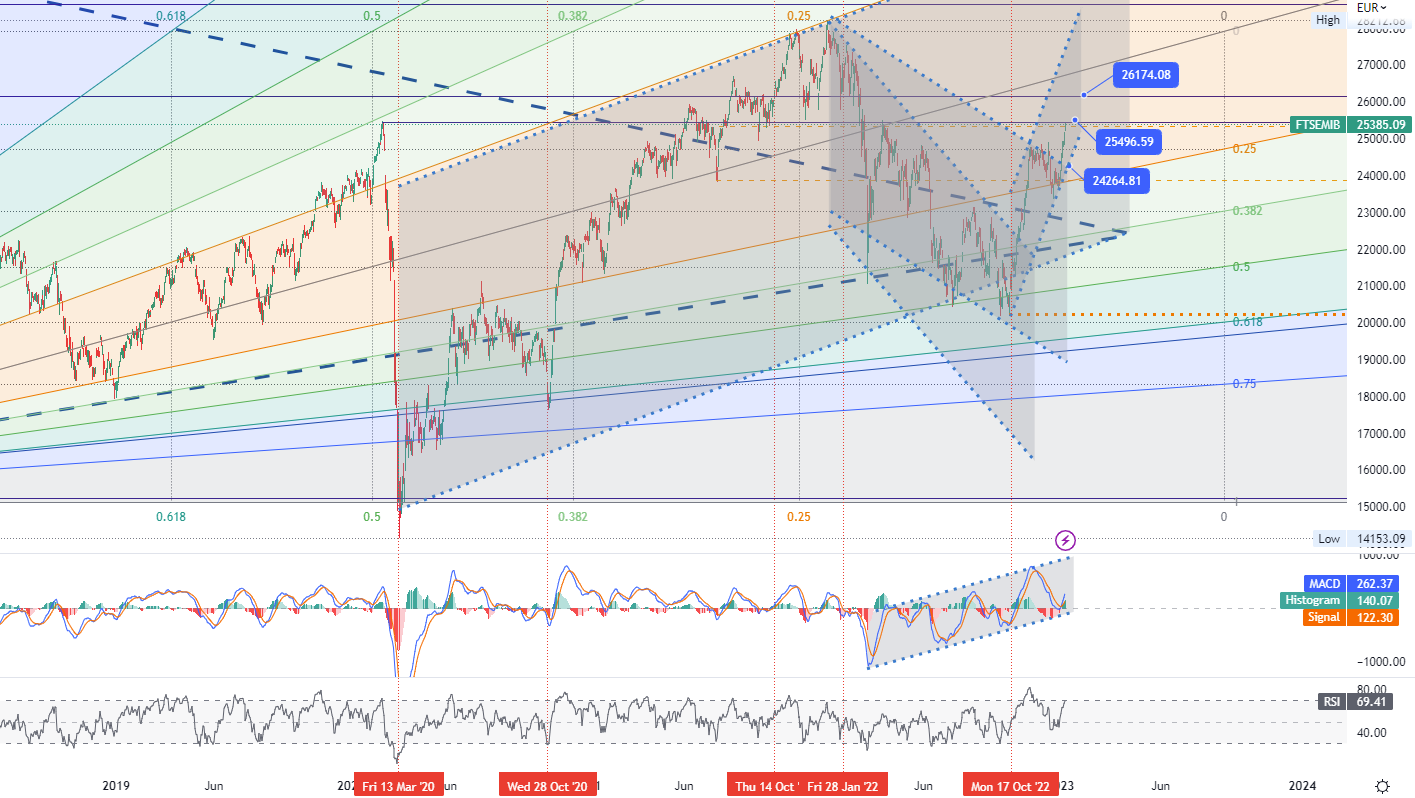
- Italy FTSE MIB index - chart (D1), Resistance (target zone) around ~ 25496 & 26174, Support (consolidation) around ~ 24264.
Start trading in four simple steps

1. Register
Open your live trading account

2. Verify
Upload your documents to verify your account

3. Fund
Deposit funds directly into your account

4. Trade
Start trading and choose from 130+ instruments
Demo account
The Blue Suisse Trading Account with virtual funds in a risk-free environment
Demo accountLive account
The Blue Suisse Trading Account in our transparent live model environment
Open an Account- Trading Account types Trading conditions Trading hours Transparency Market Information
- Products Currencies Commodities Indices Stocks
- Tools MetaTrader 4 / 5 Mobile CRM, MAM and DSP
- Education Currency Trading for Beginners How to improve your trading CFD Trading
- Partnerships Asset- and Moneymanager Tied agent White labels FIX API
- Company About us Regulatory Our philosophy Careers FAQs Contact us